Choosing a countertop often begins with a simple question: what is the difference between natural and engineered stone? The answer involves geology, manufacturing, performance, and personal priorities. Natural stone, including granite, marble, limestone, and quartzite, forms through geological processes over thousands or millions of years. Each slab shows distinct veining, mineral movement, and small imperfections. No two pieces are completely identical.
Engineered stone is manufactured from crushed minerals, resins, pigments, or cement-based binders. Quartz surfaces usually provide consistent colors and predictable patterns. This regularity can simplify kitchen planning. However, manufacturing does not make every surface indestructible. Heat, harsh chemicals, impact, and poor installation can still cause damage. Natural stone also needs informed care, especially when it has a porous surface. Sealing may reduce staining, but it does not remove every maintenance responsibility.
Architectural materials authority John Ruskin wrote, “The greatest glory in a building is not in its stones, nor in its gold.” His observation encourages a wider view of material choice. Stone should support the room’s use, atmosphere, and lifespan. Experienced fabricators also consider slab thickness, edge design, support, transport, and installation conditions. These details often matter more than showroom appearance.
There is no universally superior option. A polished marble surface may develop etching, yet those marks can become part of its character. An engineered surface may look uniform, yet some buyers may find it less expressive. The most reliable decision compares origin, composition, care requirements, environmental claims, and actual household habits. This guide examines those differences without pretending that either material is flawless.
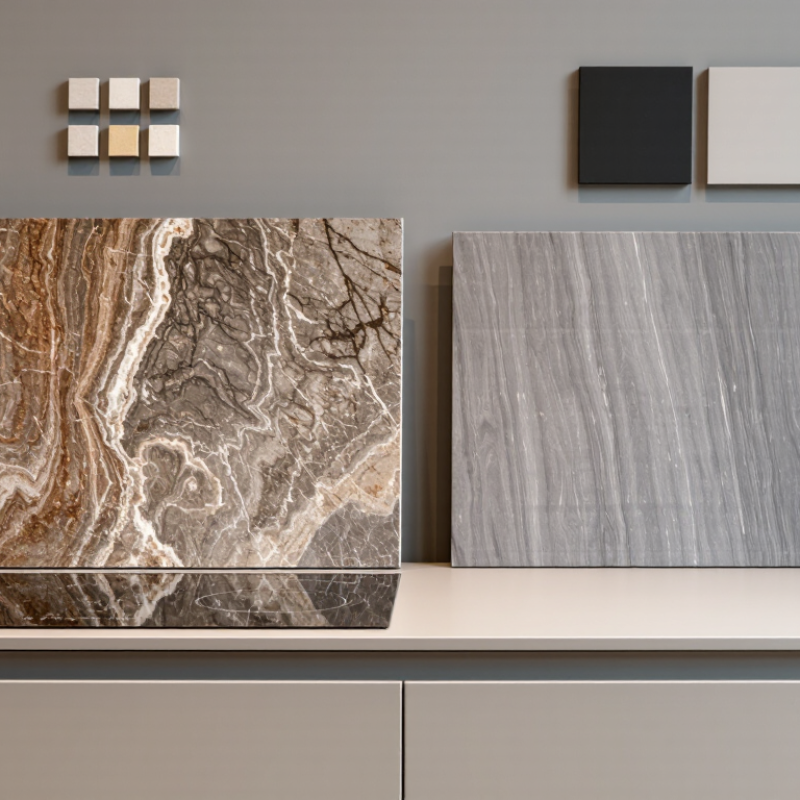
Natural stone begins as geological history, not a factory recipe. Molten rock cools, sediments compact, or minerals recrystallize under pressure. Quarry workers then cut large blocks from these formations. Each slab can show fossils, mineral veins, or tiny sealed fractures.
The common families are granite, marble, limestone, slate, and quartzite. Granite forms from cooled magma and usually offers strong resistance to scratching. Marble begins as transformed limestone, creating softer surfaces with flowing veins. Limestone often contains visible fossils and feels warmer in appearance. Slate splits into thin layers, while quartzite develops from sandstone under intense heat and pressure.
The U.S. Geological Survey’s Mineral Commodity Summaries 2024 reported U.S. dimension-stone sales of roughly 475 million dollars in 2023. That figure covers quarried building stone, not every finished countertop or tile. The Natural Stone Institute’s technical guidance also stresses that absorption, flexural strength, and surface finish should guide material selection. Color alone is not enough.
In practice, I would inspect a slab under changing light and request its technical data sheet. A dark limestone may show etching near a sink. A polished marble may reveal fingerprints more easily. These are not defects in the geological sense, but they can become maintenance issues. Some project decisions remain imperfect. Quarry variation makes exact visual matching difficult, even within one shipment.
| Comparison Dimension | Natural Stone | Engineered Stone |
|---|---|---|
| Basic Definition | Stone quarried from naturally occurring rock formations and cut or finished for use in construction and design. | A manufactured stone-based material made by combining mineral particles or stone powder with binders, pigments, and controlled manufacturing processes. |
| Geological Origin | Forms over geological time through igneous, metamorphic, or sedimentary processes within the Earth’s crust. | Does not form as a complete slab in nature. Its mineral content may be natural, but the final product is created in a factory. |
| Common Types | Granite, marble, limestone, travertine, slate, quartzite, and sandstone. | Quartz composite, engineered marble, solid-surface materials, and some sintered or porcelain-based slabs. |
| Main Composition | Composition varies by geology. Granite commonly contains quartz and feldspar; marble consists mainly of recrystallized calcite or dolomite; slate is a fine-grained metamorphic rock. | Composition depends on the product. Quartz composite commonly contains a high proportion of mineral aggregate held in a polymer-resin binder, while porcelain-based slabs are made from refined mineral materials fired at high temperatures. |
| Appearance | Each slab typically has unique veining, grain, color variation, and mineral patterns created by natural geological processes. | Patterns and colors can be more consistent and repeatable. Some products are designed to imitate marble, granite, or other natural stones. |
| Color Consistency | Variation between slabs is common, even when the material is from the same quarry. | Generally offers more predictable color and pattern matching, although variation can still occur between production batches. |
| Porosity | Varies considerably. Granite and quartzite are generally less porous than limestone, marble, and travertine, but the exact performance depends on the stone. | Often has lower and more consistent absorption than many porous natural stones. Porcelain-based products are particularly low-absorption, while resin-bound materials may have different heat and chemical limitations. |
| Stain Resistance | Porous varieties may absorb oils, acids, or colored liquids if not properly sealed and maintained. | Usually provides consistent stain resistance, but resin-bound products can still be affected by strong chemicals, prolonged heat, or abrasive cleaning methods. |
| Scratch and Wear Resistance | Depends on mineral hardness. Quartzite and granite are generally hard, while marble and limestone are more susceptible to scratching and surface wear. | Performance varies by formulation. Quartz composite is generally durable for everyday surfaces, while solid-surface materials can be more vulnerable to scratching but may be repairable by refinishing. |
| Heat and UV Performance | Many natural stones tolerate heat well, but sudden temperature changes can cause thermal shock. Some stones may discolor or weather under prolonged outdoor exposure. | Heat resistance varies. Resin-based surfaces can be damaged by hot cookware or direct heat, and some engineered colors may fade with extended ultraviolet exposure. Porcelain-based products generally perform better outdoors. |
| Maintenance | Routine cleaning is usually simple, but porous stones may require periodic sealing. Acid-sensitive stones should be cleaned with pH-neutral products. | Typically requires regular cleaning with mild soap or a manufacturer-approved cleaner. Sealing is often unnecessary for nonporous engineered surfaces, but care instructions depend on the material type. |
| Fabrication and Installation | Must be measured, cut, edged, and installed by methods suited to the stone’s hardness, thickness, weight, and natural structure. | Manufacturing can provide standardized slab sizes and controlled thicknesses, but cutting and installation still require appropriate tools and professional handling. |
| Environmental Considerations | Extraction and transportation consume energy and can alter quarry landscapes, but the material is not manufactured with synthetic binders and can have a long service life. | Production uses energy and may involve resins or other binders. Some products incorporate recycled mineral content, but environmental performance depends on the formulation, manufacturing process, transport, and durability. |
| Repairability | Chips and cracks can sometimes be repaired, but repairs may remain visible, especially in strongly veined or polished materials. | Minor damage may be repairable depending on the product. Seamless repair is more feasible for some solid-surface materials than for quartz composite or porcelain slabs. |
| Best-Known Strength | Distinctive natural character, geological authenticity, and broad variation in texture and pattern. | Controlled appearance, predictable performance, and the ability to tailor colors, patterns, thicknesses, or surface properties. |
| Key Limitation | Natural variation, possible porosity, sealing requirements, and acid sensitivity in calcium-based stones such as marble and limestone. | Performance differs widely by product category; resin-based materials may have heat or UV limitations, and some engineered materials are difficult to repair or recycle. |
| Typical Applications | Countertops, flooring, wall cladding, fireplaces, stairs, monuments, landscaping, and exterior paving. | Kitchen and bathroom countertops, vanity tops, wall panels, flooring, furniture surfaces, interior cladding, and selected exterior applications. |
| Selection Tip | Choose based on the stone’s mineral composition, porosity, hardness, intended location, finish, and willingness to accept natural variation. | Choose based on the exact product formulation, heat and UV ratings, cleaning requirements, repair options, slab dimensions, and intended application. |
It forms as magma cools, sediments compact, or minerals recrystallize under pressure. Quarrying cuts the rock into slabs. Veins, fossils, and tiny fractures may remain.
Granite, marble, limestone, slate, and quartzite are common choices. Granite usually resists scratches well. Marble has flowing veins but can etch near a sink.
Many quartz-based products contain about 90–95% crushed quartz, plus resin, pigments, and additives. Recipes vary by product grade. The blend matters.
Crushed minerals are mixed with resin and pigments, then pressed in a mold. Vacuum vibration removes much trapped air. Heating cures the resin before polishing.
Many natural stones need periodic sealing, depending on their absorption. Engineered quartz usually resists everyday stains without routine sealing. Neither surface is indestructible.
Natural stone often tolerates heat better, but sudden temperature changes may still cause cracks. Engineered stone can discolor or suffer resin damage. Use a trivet.
View a sample under your room’s changing light. Check the technical sheet for absorption, strength, and care guidance. Matching natural veins can be difficult.
Neither is automatically the greener choice. Quarrying, processing, and transport all matter. Local sourcing may reduce transport, but it does not settle the question.
Natural stone is formed by geological processes over thousands or millions of years, and common types include granite, marble, limestone, slate, and quartzite. Engineered stone, by contrast, is manufactured by combining selected mineral particles with binding materials, pigments, and controlled production methods. This process creates slabs with more predictable patterns, colors, thicknesses, and performance characteristics.
The question “what is the difference between natural and engineered stone” involves more than appearance. Natural stone offers unique variations and an organic character, while engineered stone generally provides greater consistency and may require simpler routine maintenance. Their durability, resistance to stains, heat, and scratches can vary by material and finish. Natural stone may have a higher or lower initial cost depending on its rarity, whereas engineered options often offer more predictable pricing. Environmental impact also depends on extraction, manufacturing energy, transportation, durability, and whether materials can be reused. The best choice should consider the project’s style, daily use, maintenance expectations, budget, and sustainability priorities.

 Tranquix Stone