China’s outdoor stone materials face a changing environment, not a single weather threat. Granite, limestone, marble, sandstone, and slate react differently to rain, frost, heat, sunlight, and airborne salts. Understanding how weather affects outdoor stone materials helps buyers choose suitable products for courtyards, façades, garden paths, and public spaces.
Geologist and author Steven Earle explains, “Weathering is the breakdown of rock by physical, chemical, and biological processes.” This simple definition matters in real projects. In northern China, water may enter tiny pores, freeze, expand, and loosen the surface. In coastal cities, salt can leave pale deposits and accelerate corrosion near metal fixings. Strong sunlight may fade some finishes, while repeated wetting can darken porous stone unevenly.
The details are visible. A poorly sealed limestone step may show grey edges after one rainy season. A polished marble terrace can become slippery when algae grow in shaded joints. Dense granite usually absorbs less water, but its seams and edges still need careful installation.
Experience should guide the specification, not replace testing. Suppliers should provide water absorption, freeze-thaw, slip-resistance, and finish information when available. Local climate data also deserves attention. A stone that performs well in dry western regions may struggle in a wet, freezing district.
There is no perfect material.
Even experienced buyers can overlook drainage. That mistake deserves reflection. Good outdoor stone design combines material selection, correct thickness, suitable joints, regular cleaning, and realistic maintenance expectations. This article examines China’s best stone materials through those practical weather-related risks, helping readers compare beauty, durability, cost, and long-term performance.
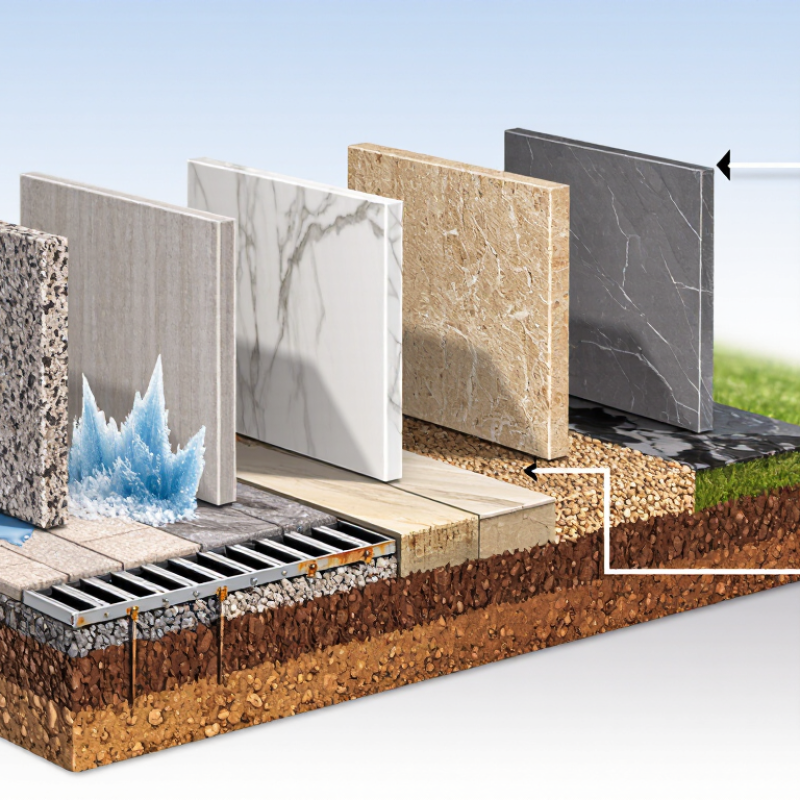
China’s granite, marble, and limestone each respond differently to weather. Granite is dense and usually resists rain, frost, and strong sunlight well. However, tiny cracks can absorb water during winter. Repeated freezing may widen them, especially on exposed steps and paving.
Marble offers attractive veining, but its calcite surface reacts with acidic rain and polluted moisture. Dull patches may appear near busy roads or drainage outlets. Limestone is generally softer and more porous. It can darken after prolonged rain, develop algae in shaded areas, and suffer surface erosion. Coastal projects face extra risks from salt carried by sea air.
On-site experience shows that installation details matter as much as stone selection. A poorly sloped ledge can hold water against otherwise durable granite. Open joints may let frost reach the backing layer. This is easy to overlook. Testing water absorption, freeze-thaw resistance, flexural strength, and slip performance gives a more reliable assessment than appearance alone. Local climate records should guide the choice, not only quarry samples.
I have seen pale limestone perform well in a dry courtyard, then stain quickly beside an unprotected garden. That result was not entirely the stone’s fault. Drainage, sealing, cleaning methods, and maintenance schedules changed its exposure. Even expert recommendations need review after a full seasonal cycle, because laboratory conditions cannot reproduce every building site.
| Stone Type | Typical Mineral Composition | Water Absorption | Freeze–Thaw Risk | Heat and Sun Exposure | Rain, Pollution, and Salt Risk | Recommended Outdoor Uses | Weather-Protection Measures |
|---|---|---|---|---|---|---|---|
| Granite | Primarily quartz, feldspar, and mica; generally an igneous stone with a dense crystalline structure. | Usually low, commonly about 0.1%–1.0% by mass, although the value varies by quarry and grade. | Low to medium | Generally good resistance to sunlight and temperature changes. Dark colors may become noticeably hotter in direct sun. | Usually resistant to rain and urban pollution. Coastal salt can affect exposed joints, microcracks, and metal fixings more than the stone itself. | Exterior paving, steps, façades, retaining walls, countertops, monuments, and high-traffic public areas. | Use frost-resistant grades, seal water-entry points, provide drainage, avoid trapped water, and inspect joints and anchors regularly. |
| Marble | Metamorphic carbonate stone composed mainly of recrystallized calcite or dolomite. | Low to moderate, often about 0.1%–2.0%, depending on grain structure, fissures, and finish. | Medium | Usually stable in sunlight, but some colors and mineral veins can fade or change visually over long-term UV exposure. Thermal expansion may stress thin panels. | Sensitive to acidic rain, sulfur pollutants, and de-icing salts. Acidic substances can cause dull spots and surface etching. | Covered façades, sheltered paving, architectural details, entrance areas, and carefully designed exterior cladding. | Apply a suitable breathable sealer, use neutral-pH cleaners, design effective drainage, avoid acidic chemicals, and select exterior-rated marble. |
| Limestone | Primarily calcite, formed from sedimentary carbonate material; porosity can vary considerably. | Moderate to high, commonly about 1%–15% or more for highly porous varieties. | Medium to high | Generally tolerates normal sunlight, but high heat can accelerate drying, salt movement, and cracking where moisture is trapped. | Vulnerable to acidic rain, pollution, biological growth, staining, and salt crystallization, especially when porous. | Dry-climate façades, sheltered walls, decorative masonry, low-traffic paving, and areas with good drainage. | Choose dense low-absorption grades, use breathable water repellents, keep surfaces clean, prevent standing water, and repair open joints. |
| Slate | Fine-grained metamorphic stone, commonly containing clay minerals, mica, and quartz. | Low to moderate, often about 0.2%–3.0%, but cleavage planes can allow water penetration. | Medium | Usually performs well in sunlight. Repeated heating and cooling may open cleavage planes in lower-quality material. | Generally good resistance to rain, but salts and trapped moisture can cause flaking, delamination, or surface powdering. | Roofing, wall cladding, paving, steps, and landscaping in regions with suitable freeze–thaw specifications. | Specify sound, non-delaminating material; install with proper slope and drainage; use compatible bedding and inspect for flaking. |
| Quartzite | Very hard metamorphic stone composed predominantly of interlocking quartz grains. | Very low, commonly below 1%, although fractures and veins can increase local absorption. | Low | Excellent resistance to UV exposure, abrasion, and normal outdoor temperature variation. | Generally resistant to rain and most pollutants. Salt-related damage is more likely at joints, cracks, and poorly drained edges. | Exterior paving, stairs, heavy-use façades, retaining walls, and exposed landscaping features. | Use mechanically sound slabs, provide movement joints, prevent water retention, and seal only when recommended for the specific finish. |
| Travertine | Porous carbonate stone, usually composed mainly of calcite with natural cavities and layered textures. | Moderate to high, commonly about 1%–10% or more before filling and finishing. | Medium to high | Sunlight is generally acceptable, but strong temperature cycles can stress filled cavities and weak layers. | Acidic rain, salt, moisture, and biological growth can cause discoloration, erosion, and deterioration of filled pores. | Covered patios, sheltered façades, pool surrounds with appropriate detailing, and low-to-medium traffic paving. | Fill and seal suitable surfaces, use frost-rated material in cold regions, provide drainage, and clean with non-acidic products. |
| Sandstone | Clastic sedimentary stone composed mainly of sand-sized quartz and feldspar particles bound by natural cement. | Moderate to high, often about 1%–10%, with significant variation among types. | Medium to high | Normally stable under sunlight, but thermal cycling can worsen pre-existing weakness, bedding-plane separation, and moisture-related damage. | May be affected by salt crystallization, wind-driven rain, pollution, staining, and biological growth depending on porosity and cement type. | Dry-climate façades, garden walls, landscaping, sheltered paving, and projects using verified exterior-grade material. | Orient bedding correctly, use breathable protection, detail generous overhangs and drainage, and avoid saturated installation conditions. |
| Basalt | Dense dark volcanic stone composed mainly of plagioclase feldspar, pyroxene, and sometimes olivine. | Generally low, often about 0.1%–2%, but vesicular or heavily fractured varieties may absorb more water. | Low to medium | Good resistance to UV exposure and abrasion. Dark surfaces can reach high temperatures under direct sunlight. | Usually resistant to rain and pollution; coastal salt may attack surface defects, joints, and adjacent construction materials. | Exterior paving, steps, façades, curbs, landscaping, and other high-wear applications. | Verify density and absorption, provide expansion joints for large areas, use slip-resistant finishes, and avoid water traps. |
| General Weather-Selection Guideline | For cold or wet climates, prioritize low water absorption, verified freeze–thaw performance, sound structure, and effective drainage. In hot or sunny climates, consider surface temperature, thermal movement, color stability, and suitable installation joints. Carbonate stones such as marble, limestone, and travertine require extra protection from acidic rain and salt exposure. | ||||||
Dense granite generally performs well outdoors. Tiny cracks may still absorb water. Repeated freezing can widen those cracks, especially on exposed steps and paving.
Marble contains calcite, which reacts with acidic rain and polluted moisture. Dull patches may form near traffic, drainage outlets, or other wet areas.
Limestone is softer and more porous than many granite types. Long rain can darken it. Shade may encourage algae, while coastal air can carry damaging salt.
Not always. A poorly sloped ledge can hold water against durable granite. Open joints may let frost reach the backing layer. Details matter.
Many natural stones expand about 4–10 × 10⁻⁶/K. A four-metre limestone panel may move roughly 0.64–1.60 millimetres after a 40°C change.
Rigid anchors may restrain normal expansion. Stress can gather around holes, corners, and thin edges. Dark façades may become much hotter than shaded stone.
Check water absorption, freeze-thaw resistance, flexural strength, compressive strength, and slip performance. Thermal expansion testing can also help. Appearance alone is weak evidence.
Request batch-level test reports, not only catalogue values. Inspect cut edges and backs for fissures. Test a small site sample when possible. One test is not enough.
Yes. Drainage, sealing, cleaning, and maintenance all change exposure. Pale limestone may stay clean in a dry courtyard, then stain beside an unprotected garden.
Review it after a full seasonal cycle. Laboratory testing cannot reproduce every site condition. Local pollution, salt, wetting, drying, and temperature swings may reveal unexpected weaknesses.
Choosing the right stone for outdoor applications in China requires understanding how weather affects outdoor stone materials. Granite, marble, and limestone respond differently to moisture, temperature changes, and repeated freezing. Water absorption is a key consideration, with typical rates ranging from about 0.1% to 3.0%; stones with lower absorption generally offer better resistance to rain, frost, and staining. Before installation, materials should be evaluated through 25–50 freeze–thaw weathering cycles to identify cracking, surface loss, or structural weakness.
Thermal stress is another important factor because stone expands and contracts as temperatures change, commonly at a rate of 4–10 × 10⁻⁶/K. This movement can affect large panels, joints, and exposed surfaces over time. For reliable selection, projects should consider local climate, drainage, maintenance needs, and testing requirements under China’s GB/T 19766 and GB/T 18601 standards. These factors help match each stone type with suitable outdoor conditions and improve long-term performance.

 Tranquix Stone