7 Tips for Combining Stone and Modern Landscape Design

Time:2026-11-25 Author:Mason
0%

Stone can make a modern landscape feel grounded, textured, and enduring. A pale limestone path, for example, can soften the crisp lines of a dark steel planter. Yet stone is not automatically the right choice everywhere. Too much can make a garden feel hard, cold, or difficult to maintain.

The key is knowing how to combine stone and modern landscape design without letting either element dominate. Start with the site itself: observe how sunlight moves, where rainwater collects, and how people use the space. These details help guide choices about stone size, finish, placement, and planting. Smooth pavers may suit a clean patio, while rougher stone can create a more natural edge beside ornamental grasses. Keep the palette restrained. Two complementary stone types often feel more intentional than several competing colors and textures.

Small details matter. A narrow gravel joint, a warm light along a low wall, or a patch of greenery beside a stone step can change the whole mood. Still, a perfectly ordered layout may feel a little too formal. That is worth reconsidering. Allowing plants to soften a hard edge can make the design more welcoming over time. Drainage, slip resistance, and maintenance also deserve attention, especially on paths and slopes. For complex retaining walls or water-management concerns, advice from a qualified landscape professional can prevent costly mistakes. The seven tips ahead offer practical ways to balance clean modern lines with stone’s natural character.
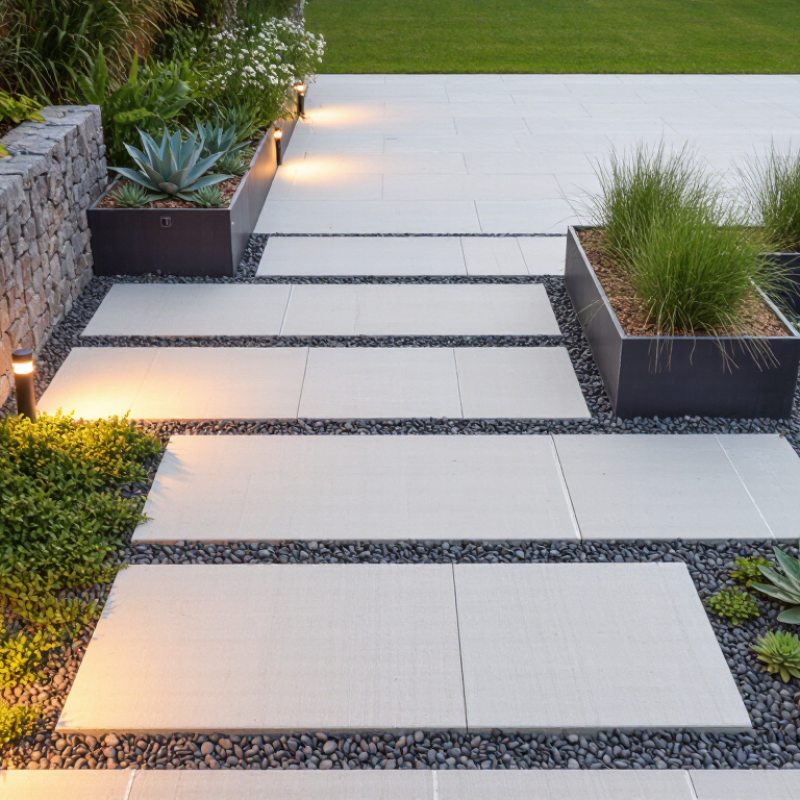
7 Tips for Combining Stone and Modern Landscape Design

Assess Site Water Needs: EPA Estimates Outdoor Use at 30% of U.S. Household Water

The U.S. Environmental Protection Agency estimates that outdoor use accounts for about 30% of household water use nationwide. Local conditions can shift that figure, but it is a useful reason to assess a yard before choosing stone or plants. Walk the site after watering or rain. Notice where soil stays damp, where runoff crosses a path, and which corners bake in afternoon sun. Small details matter.

Stone can make a modern landscape feel calm and structured, but large paved areas may shed water rather than help the garden use it. Keep planting beds connected to suitable runoff areas, and consider permeable joints where the ground and drainage conditions allow. Choose plants suited to local rainfall, then group them by water needs so thirsty plants do not dictate irrigation for the whole yard. Drip lines can deliver water near roots, though they still need seasonal checks. A cracked fitting is easy to miss. It is also easy to overestimate how little water a new garden needs; monitor soil moisture and adjust gradually. A simple rain gauge can help reveal whether scheduled watering is necessary.

Select Stone by Performance: Compare ASTM C97 Absorption and ASTM C170 Strength

Stone should earn its place through performance, not color alone. For a garden path beside sprinklers, water absorption affects how much moisture enters the stone. ASTM C97/C97M measures absorption by comparing a dried specimen’s mass with its mass after water immersion. Lower absorption can be useful in wet settings, but it does not prove a stone will resist every stain, freeze-thaw cycle, or installation problem. Numbers matter.

Strength matters underfoot and beneath heavy planters. ASTM C170/C170M measures compressive strength by loading a stone specimen until it fails. As a useful benchmark, ASTM C615/C615M specifies granite with maximum absorption of 0.40% and minimum compressive strength of 19,000 psi, about 131 MPa. Those are specification values for granite, not universal pass marks for every stone type or landscape use.

Ask for test results for the specific stone and finish being supplied, and check that the report identifies its test methods and units. A polished sample may not represent a rough, weather-exposed surface. I would also compare the report with the project’s actual loads and drainage conditions; that step is easy to overlook. A strong reading alone cannot fix poor drainage.

Set Accessible Stone Paths Within the ADA’s 1:48 Maximum Cross-Slope

A stone path can feel natural without making access an afterthought. For an accessible route, keep the cross-slope—the side-to-side tilt—within the ADA’s 1:48 maximum where the standards apply. That equals about ¼ inch of rise per foot of width. Small changes matter.

Choose stone with relatively even surfaces, then set each piece firmly in a stable base. A two-foot level and measuring wedge can reveal a slope that looks flat to the eye. Check across the path at several points, especially where stones meet or the route bends. Keep joints narrow and firm enough to avoid catching wheels, canes, or shoe tips. No loose edges.

Rain still needs somewhere to go. Shape surrounding planting beds to handle runoff rather than tilting the walking surface beyond its limit. A gentle lengthwise grade is a separate measurement, so check both directions; other accessibility requirements may apply. Stone varies, and the first layout may need adjustment. Ask a qualified accessibility professional to review the plan and verify applicable local requirements before installation.

Combine Permeable Joints and Planting to Manage Stormwater Runoff

Stone can make a modern garden feel grounded, but solid paving may send rainwater rushing toward doors or low spots. Permeable joints offer a practical alternative. Leave consistent gaps between stone slabs and fill them with clean, angular aggregate suited to the paving system. Water can pass through the joints into a prepared base, where it may soak into the soil or move toward a designed drainage area. Small details matter.

Tip: Check the site before choosing joint width or stone spacing. Compact clay soil absorbs water slowly, while a steep slope can carry runoff across the surface. A simple observation during rain can reveal where water collects. I would not assume that permeable joints alone can handle a heavy storm; the base, soil, and drainage route all affect performance.

Tip: Pair the paving with plants that tolerate the site’s wet-and-dry cycles. A shallow planted swale beside a path can slow runoff and catch sediment before it reaches a drain. Use a clear overflow route for storms that exceed the garden’s capacity. Keep leaves and fine soil out of the joints, and inspect them seasonally. It is easy to overlook maintenance. If water remains pooled long after rain, review the grading and soil conditions before adding more stone.

7 Tips for Combining Stone and Modern Landscape Design - Combine Permeable Joints and Planting to Manage Stormwater Runoff

Tip Design Detail Practical Guideline Stormwater Benefit
1. Choose permeable joint spacing Use open joints between suitable stone units and fill them with clean, free-draining aggregate. For permeable interlocking concrete pavers, joint openings are commonly about 6–15 mm; follow the paving system and stone specifications. Open joints let rainfall pass into the bedding and base layers instead of immediately running across the surface.
2. Match the base to the site Build a stable, open-graded aggregate base beneath permeable paving. Base depth depends on soil, traffic, frost conditions, and storage needs; confirm it with a site-specific pavement design. The aggregate reservoir temporarily stores water and can support infiltration where underlying soils allow it.
3. Direct runoff toward planting Use subtle grading, stone edging, or shallow channels to guide water toward a planted basin. Keep surfaces graded so water moves away from buildings and toward a designed landscape drainage area. A planted receiving area can slow, spread, and filter runoff before it reaches a drain or downstream area.
4. Select plants for wet and dry cycles Combine locally appropriate plants that tolerate both periodic saturation and dry intervals. Choose species suited to the local climate, soil, sun exposure, and expected ponding duration. Roots and foliage help maintain soil structure, slow surface flow, and support infiltration.
5. Keep soil and mulch out of the joints Separate planting beds from permeable paving with a stable edge and manage loose materials near the surface. Avoid sweeping topsoil, fine sand, or organic mulch into open joints; use joint aggregate specified for the paving system. Keeping sediment out helps preserve the open pathways that allow water to enter the pavement.
6. Use stone to define—not block—water paths Arrange stepping stones, gravel bands, or low stone borders without creating unintended barriers to drainage. Check the finished grading after installation and provide a safe overflow route for storms that exceed the design capacity. Clear flow paths reduce ponding in unwanted locations and help direct excess water to an appropriate outlet.
7. Inspect and maintain regularly Check joints, planted areas, inlets, and overflow routes, especially after major storms. Remove accumulated sediment and debris; replenish joint aggregate or replace plants as needed. Routine care helps maintain infiltration pathways and keeps the combined stone-and-planting system functioning.

Note: Joint dimensions and drainage performance vary by paving material, installation, soil, climate, and local requirements. Confirm project details with applicable codes and site-specific design guidance.

Plan Stone Sizes, Colors, and Maintenance for Long-Term Landscape Use

Stone works best when its dimensions match the job. Use broad, stable slabs for steps and paths, and smaller pieces for curved edges or tight planting beds. Confirm thickness and load suitability with the supplier; appearance alone does not reveal strength. The Natural Stone Institute points designers toward testing such as ASTM C97 for water absorption and ASTM C880 for flexural strength. Ask for test results, especially where freeze-thaw cycles or heavy foot traffic are expected. Measure twice. Cutting stone later creates waste and mismatched edges.

Color needs testing in place. View samples in sun and shade, both wet and dry; a charcoal paver can look nearly black after rain. USGS estimated U.S. crushed-stone production at about 1.5 billion tons in 2023, underscoring how widely stone serves construction. For a landscape, however, locally available stone may reduce transport and blend more naturally with nearby soil and buildings. I still find color matching easy to underestimate.

Plan maintenance around drainage and joints. Keep water moving away from steps and foundations, and choose joint material suited to the expected use. EPA reported 600 million tons of U.S. construction and demolition debris in 2018; demolition generated about 90 percent. Reusing sound salvaged stone can keep material in service, but inspect pieces for cracks and inconsistent thickness. Seal only when the stone supplier recommends it. A sealed surface can still stain, and poorly managed runoff can leave algae in shaded joints.

FAQS

How much household water may go to outdoor use?

Outdoor use accounts for about 30% of household water nationwide. Local weather and yard conditions can change that share.

What should I check before choosing stone or plants?

Walk the yard after rain or watering. Note damp soil, runoff paths, and corners that bake in afternoon sun.

Can permeable joints prevent all stormwater problems?

No. Soil, slope, base preparation, and drainage routes all affect performance. Heavy rain can still overwhelm a garden.

How should I choose the gaps between stone slabs?

Check soil and slope before setting joint widths. Use clean, angular aggregate suited to the paving system.

Which plants work well beside stone paths?

Choose plants that tolerate the site’s wet-and-dry cycles. Group them by water needs, and consider a shallow planted swale.

How can I tell whether scheduled watering is needed?

Check soil moisture and use a simple rain gauge. Adjust watering gradually; new gardens may need more than expected.

What should I ask about stone strength?

Confirm thickness and load suitability with the supplier. Ask for test results when freeze-thaw conditions or heavy foot traffic are expected.

How can I choose a stone color confidently?

View samples in sun and shade, both wet and dry. Charcoal stone can look nearly black after rain. Easy to misjudge.

Can salvaged stone be reused?

Yes, if pieces are sound. Check for cracks and uneven thickness before using them in a path or bed edge.

How often do stone joints need attention?

Inspect them seasonally and clear leaves or fine soil. If water stays pooled, review grading and soil conditions. It is easy to overlook.

Conclusion

This guide explains how to combine stone and modern landscape design by starting with the site’s water needs and the way people will use the space. Outdoor water use accounts for an estimated 30% of household water in the United States, so thoughtful planting and efficient irrigation can help reduce unnecessary consumption. Choose stone for its intended purpose, comparing water absorption under ASTM C97 and strength under ASTM C170 to help ensure it can withstand local conditions and regular use.

For safer, more comfortable access, plan stone paths with a cross-slope no steeper than 1:48. Permeable joints paired with suitable planting can help manage stormwater runoff while adding a softer contrast to stone surfaces. Finally, consider stone sizes, colors, and maintenance needs together: a coordinated, durable palette can support a contemporary look while keeping the landscape practical over time. These choices offer a clear starting point for how to combine stone and modern landscape design.

Mason

Mason

Mason is a seasoned marketing professional with a deep expertise in the company's offerings and a passion for driving brand awareness. With a strong background in digital marketing strategies, he has an innate ability to connect with diverse audiences and effectively communicate product benefits.......