Choosing flooring for airports, hotel lobbies, shopping centers, and busy public corridors requires more than attractive photographs. The practical question is: what is the most durable stone for heavy traffic areas? In many projects, granite performs exceptionally well because it combines high abrasion resistance, low water absorption, and strong compressive performance. Dense quartzite can also be an excellent choice, although its fabrication may require specialized tools and experienced installers.
The Natural Stone Institute’s Dimension Stone Design Manual recommends evaluating stones through measurable physical properties, not appearance alone. ASTM C241/C241M measures abrasion resistance, while ASTM C97/C97M evaluates absorption and bulk specific gravity. These tests matter beneath real footsteps, grit, rolling luggage, and metal cart wheels. The U.S. General Services Administration also emphasizes life-cycle performance when selecting durable interior materials. Initial price can mislead.
Fred Hueston, Ph.D., a stone-care consultant and author, states, “The best stone is the one selected for the environment and maintained correctly.” That principle deserves attention. Even granite can stain, scratch, or lose its finish when installers ignore joints, cleaning methods, or entrance mats.
There is no universal winner.
A polished surface may become slippery or visibly worn. A honed finish can hide scratches, but it may require more frequent cleaning. Quartzite offers impressive hardness, yet not every product sold under that name has identical performance. Testing the exact quarry material is wiser than trusting a label.
This guide compares durability, maintenance, finish, installation quality, and life-cycle value. It also examines where common assumptions fail. A beautiful stone can still be the wrong stone.
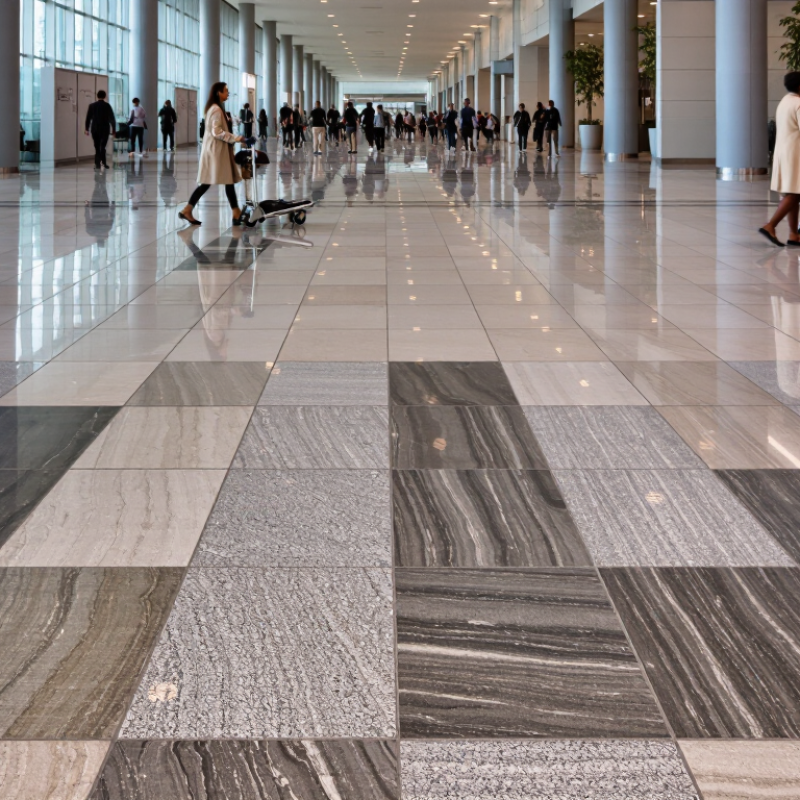
Durable stone selection starts with defining traffic, not choosing a color. Record daily footfall, trolley movement, grit exposure, moisture, and impact risks. A hotel lobby may receive thousands of footsteps daily, while a private corridor may receive fewer than 50. Those conditions are not comparable. Entrance zones deserve the highest classification because sand acts like loose abrasive.
Use the Natural Stone Institute’s Dimension Stone Design Manual to structure the assessment. For heavy traffic, request laboratory results for abrasion resistance, water absorption, compressive strength, and flexural strength. ASTM C241/C241M measures abrasion resistance, while ASTM C170/C170M evaluates compressive strength. These tests reveal performance differences that polished samples hide. Ask for results from the proposed batch, not only generic quarry data. Stone can vary.
Slip resistance needs equal attention. ANSI A326.3 commonly references a wet dynamic coefficient of friction of 0.42 for level interior flooring, but this value is not a universal safety guarantee. Surface texture, contamination, footwear, and maintenance can change actual performance. Honed or textured finishes often offer better practical traction than highly polished surfaces. Still, rougher is not automatically safer. A rough surface may trap dirt and become difficult to clean. My imperfect rule is simple: specify measurable thresholds, inspect a full-size mock-up, and challenge the decision with wet, gritty, wheeled-traffic conditions before installation. Small oversights become expensive repairs.
Record daily footsteps, trolley movement, grit, moisture, and impact risks. An entrance may receive thousands of footsteps daily. A private corridor may receive fewer than 50. Those areas need different performance requirements.
Sand and grit act like loose abrasives under shoes and trolley wheels. They can dull finishes and create scratches quickly. Inspect entrance conditions carefully. Small oversights may cause expensive repairs.
Request abrasion resistance, water absorption, compressive strength, and flexural strength results. These tests reveal weaknesses hidden by attractive polished samples. Ask for results from the proposed batch. Generic quarry data may not reflect actual variation.
Polished stone may look impressive but become slippery when wet. Muddy footprints near an entrance can change the risk quickly. Honed or textured finishes often provide better practical traction. Appearance alone is not enough.
No. Rougher is not automatically safer. Deep texture may trap dirt and require stronger cleaning routines. Test the surface with dry and damp shoes. Test it wet.
Place the mock-up where people can walk across it. Test dry shoes, damp shoes, grit, water, and wheeled traffic. Observe cleaning results and visible dirt after use. Small samples can hide practical problems.
Consider spills, traffic patterns, grit, cleaning frequency, and surface texture together. Textured stone may improve grip but hold more dirt. Honed stone can offer a practical balance in corridors and lobbies. Sealers reduce staining, but they do not remove maintenance needs.
Request measured slip-resistance data from a qualified supplier. A common benchmark may help guide decisions, but it is not a universal safety guarantee. Surface texture, contamination, footwear, and cleaning can change performance. Real conditions matter more.
Yes. Recheck the surface after several weeks of real use. Look for muddy footprints, dull patches, trapped dirt, and difficult cleaning. This step is easy to skip. It may expose poor assumptions.
Choosing durable stone for heavy traffic areas begins with understanding the site’s traffic level, expected loads, climate, and performance requirements. The key question, “what is the most durable stone for heavy traffic areas,” cannot be answered by appearance alone. Natural stones with high hardness, low porosity, strong wear resistance, and consistent structure generally perform better in busy entrances, corridors, retail spaces, and public facilities. Each stone type should be compared according to its resistance to abrasion, impact, staining, and moisture.
Surface finish is equally important because it affects slip resistance, cleaning, and long-term maintenance. Before installation, verify the substrate condition, stone thickness, joint design, drainage, and structural support to ensure the surface can handle repeated loads. Practical testing, such as abrasion and slip testing, can help confirm suitability. Finally, evaluate the complete lifecycle cost, including installation, sealing, cleaning, repairs, and replacement. The best choice is the stone that balances durability, safety, appearance, maintenance demands, and total ownership cost.

 Tranquix Stone