2026 Top Benefits of Stone Landscaping for Global Buyers?

Time:2026-09-14 Author:Charlotte
0%

What are the benefits of stone landscaping for global buyers in 2026? The answer begins with performance, not appearance. Properly selected stone can create durable paths, retaining walls, drainage edges, terraces, and low-maintenance garden zones. It also gives outdoor spaces a tactile identity: warm limestone under morning light, dark basalt beside planting beds, or local granite defining a long entrance walk.

The U.S. Environmental Protection Agency explains that well-designed green infrastructure can reduce stormwater runoff and support water-quality goals. Stone alone is not green infrastructure. However, permeable joints, graded surfaces, and planted edges can improve site performance. The Natural Stone Institute’s technical guidance also stresses correct installation, drainage, freeze-thaw suitability, and maintenance planning. These details matter greatly across climates. A beautiful stone can fail when its absorption rate, thickness, or slip resistance is ignored.

Piet Oudolf, a respected landscape designer, has said, “I don’t want to make a garden that looks good only in summer.” His principle supports year-round planning, where stone provides structure after flowers fade. The 2024 Houzz & Home Study also reflects continuing homeowner investment in outdoor improvements, although buyer priorities differ by region. Global purchasers should therefore compare lifecycle cost, quarry distance, certification, labor, and replacement availability. Local stone may reduce transport impacts, but not automatically. Imported stone may offer better performance, yet create longer supply chains. That is the uncomfortable part. Stone landscaping is durable, but poor sourcing and careless detailing can undermine its environmental value. This guide examines the strongest benefits with practical limits.
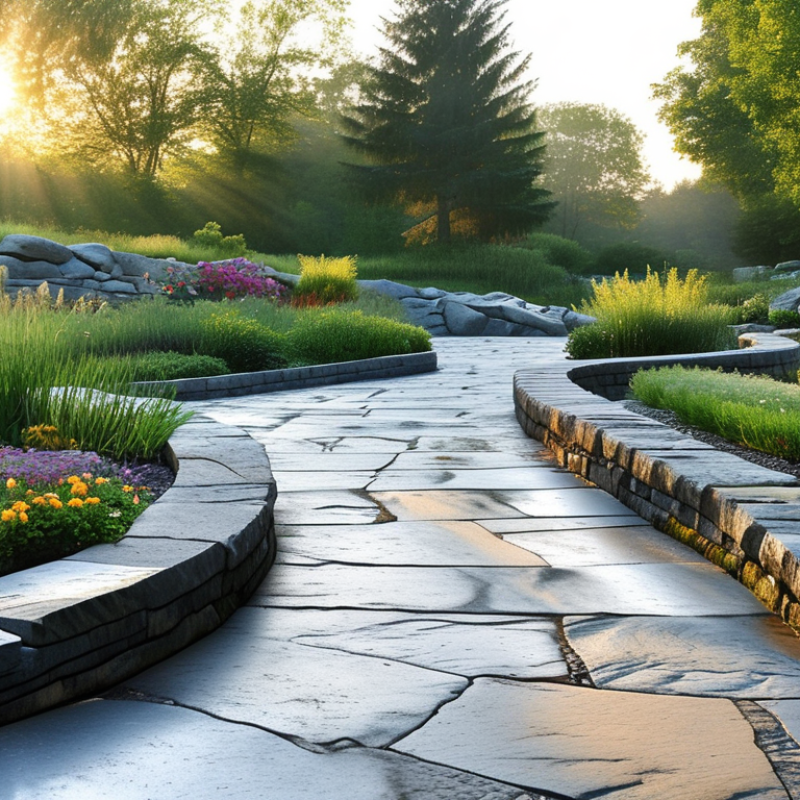
2026 Top Benefits of Stone Landscaping for Global Buyers?

Stone Landscaping Explained: Materials, Uses, and Global Buyer Criteria

Stone landscaping uses natural or engineered stone to shape outdoor spaces with strength, texture, and visual balance. Common materials include granite, limestone, sandstone, slate, and basalt. Granite suits heavy-traffic paving because it resists abrasion. Limestone creates softer garden paths, but some varieties require sealing. Sandstone offers warm colors and a slightly rough surface. Slate works well for steps, although uneven layers can create trip risks.

Typical uses include patios, walkways, retaining walls, water features, edging, and outdoor seating. Material choice should follow the site, not only the desired appearance. A coastal project may need low-absorption stone and corrosion-resistant fixings. In freeze-thaw regions, buyers should request water absorption and durability data. Slip resistance matters near pools and frequently wet entrances. Small details matter.

Global buyers need clear product specifications, sample pieces, packing information, and consistent quality records. Ask for quarry origin, dimensions, thickness tolerance, surface finish, and test reports from recognized laboratories. Color variation is natural, so one photograph cannot represent a full shipment. I have seen projects fail when buyers approved attractive samples without checking container packaging. Broken corners and mixed batches can raise installation costs. A better process compares samples, drawings, climate data, and delivery conditions before payment. Exact visual matching remains difficult, even with careful controls.

Durability Economics: 50–100-Year Service Life in Natural Stone Projects

Natural stone landscaping can deliver strong long-term value for global buyers. Properly selected stone may serve for 50–100 years, especially in paths, retaining walls, terraces, and public courtyards. This lifespan changes the economic calculation. A higher purchase price can become reasonable when replacement, disposal, and repeated installation costs are reduced.

Durability depends on more than stone hardness. Freeze-thaw cycles, salt exposure, drainage, soil movement, and installation quality all influence service life. In cold regions, poor drainage can trap water beneath paving and cause cracking after repeated freezing. In hot climates, intense sunlight may affect sealants and surface comfort. Experienced contractors usually inspect local geology, water flow, and expected foot traffic before choosing thickness and finish.

Natural variation also requires practical judgment. Some slabs contain veins, small pits, or color shifts. These features are not always defects, but they can complicate large, uniform designs.

I have seen projects overspend on premium stone while ignoring weak foundations. The stone survived; the installation did not. That lesson matters.

A realistic budget should include excavation, base preparation, skilled labor, drainage, cleaning, and occasional joint repairs. Maintenance remains limited, not nonexistent. With documented sourcing, suitable testing, and climate-aware installation, natural stone can support durable landscapes across residential and commercial projects. Conditions still matter. No service-life estimate should be treated as a guarantee.

Stormwater Control: Permeable Stone Systems Reduce Runoff by 50–90% (EPA)

For global buyers, stone landscaping is more than a visual upgrade. It can become practical stormwater infrastructure. The U.S. Environmental Protection Agency reports that permeable pavement systems can reduce runoff by approximately 50–90%, depending on soil, rainfall, and design quality. Water passes through stone joints instead of rushing across sealed surfaces. During a cloudburst, this difference can prevent flooded paths and overloaded drains.

The Federal Highway Administration notes that newly installed permeable pavement may achieve infiltration rates above 100 inches per hour. A compacted aggregate base temporarily stores water below the surface. Geotextile layers can also limit soil migration when correctly specified. These details matter for driveways, courtyards, resorts, and commercial entrances. Local rainfall records should guide the stone size, base depth, and slope.

The weak point is maintenance. Leaves, dust, and construction sediment can clog joints over time. EPA guidance recommends routine inspection and periodic vacuum cleaning for permeable surfaces. No system is magic. In clay soils or areas with a high water table, infiltration may perform poorly without drainage adjustments. Buyers should request soil testing, rainfall calculations, and installation records before approving a project. A beautiful surface can still fail quietly beneath the stones.

Sustainable Sourcing: Life-Cycle Assessment Under EN 15804:2012+A2:2019

2026 Top Benefits of Stone Landscaping for Global Buyers?

Sustainable Sourcing: Life-Cycle Assessment Under EN 15804:2012+A2:2019

Stone landscaping can offer long service life, low maintenance, and strong resistance to weather. These qualities matter to buyers planning public spaces, gardens, and commercial developments. Yet durability alone does not prove sustainability. A credible assessment must examine the complete product life cycle.

Under EN 15804:2012+A2:2019, life-cycle assessment considers environmental impacts across defined stages. Quarrying and processing appear in modules A1 to A3. Transport and installation may involve A4 and A5. Future maintenance, reuse, or disposal can affect later modules. Buyers should review the declared modules carefully, rather than comparing isolated carbon figures. Verified environmental product declarations can improve transparency when their scope and data quality are clear.

Practical experience shows that local stone may reduce transport emissions, but this is not automatic. Extraction methods, cutting losses, fuel use, packaging, and shipping distances all change the result. Data gaps remain. That is uncomfortable. A responsible supplier should explain assumptions, electricity sources, recycled content, and material yield. Buyers can also request quarry-specific evidence and compare functional performance over the expected service life. A thinner product may appear efficient, yet require earlier replacement. The better question is often simple: how long will it perform, and what happens afterward?

2026 Top Benefits of Stone Landscaping for Global Buyers? - Sustainable Sourcing: Life-Cycle Assessment Under EN 15804:2012+A2:2019

Assessment Dimension Data / Indicative Value Buyer-Relevant Interpretation EN 15804+A2:2019 Reference Verification Priority
Material composition Natural stone is primarily mineral material; common landscaping stones have a typical bulk density of approximately 2,500–2,700 kg/m³. High density supports durable paving, retaining walls and edging, but increases transport-related impacts per unit of product. A1: raw material supply; A3: manufacturing and processing. Product-specific technical data sheet and EPD.
Life-cycle boundary Use a cradle-to-grave assessment covering A1–A3, A4, A5, B, C and D, where relevant to the declared product and application. A complete boundary prevents buyers from comparing quarry-gate data with transport-inclusive or end-of-life data as if they were equivalent. EN 15804:2012+A2:2019 modular life-cycle structure. Confirm declared modules and system boundary.
Product stage: quarrying and processing A1–A3 includes extraction, cutting, shaping, surface finishing, electricity, fuels, water use, packaging and manufacturing waste. Local processing, efficient cutting plans and renewable or lower-carbon electricity can reduce the product-stage burden. A1–A3. Energy mix, cutting yield, fuel consumption and waste-recovery records.
Transport sensitivity Transport impact is calculated from product mass, distance, transport mode, load factor and fuel or electricity consumption. Because stone is heavy, long-distance shipping can materially affect the result. Compare regional sourcing and consolidated shipments rather than product carbon data alone. A4: transport to the construction or installation site. Declared origin, destination, route distance, mode and shipment mass.
Installation materials A5 may include bedding sand, mortar, concrete, geotextiles, jointing materials, installation energy, packaging and site waste. Dry-laid or mechanically installed systems may reduce dependence on cementitious materials, subject to structural and local drainage requirements. A5: construction and installation process. Installation method, accessory quantities and site-waste rate.
Durability and service life Natural stone can provide long service in outdoor applications when the stone type, thickness, finish, drainage design and installation are suitable. A project service-life period must be defined by the assessment. A longer replacement interval can lower annualized impacts, but durability should not be assumed without application-specific evidence. B4: replacement; B5: refurbishment; reference study period. Abrasion, freeze–thaw, slip resistance, chemical resistance and maintenance requirements.
Maintenance demand Routine maintenance generally consists of sweeping, washing, joint maintenance and occasional replacement of damaged pieces; actual frequency depends on climate, traffic and finish. Low-maintenance designs can reduce operational water, cleaning products, equipment use and replacement materials. B2: maintenance; B3: repair; B4: replacement. Document cleaning frequency, water use, detergents and repair assumptions.
Reuse potential Whole stone units can often be dismantled and reused when installed without permanent bonding and when they remain technically suitable. Design for disassembly can reduce demand for virgin material in future projects. C1–C4: end-of-life; D: benefits and loads beyond the system boundary, when justified. Take-back route, recovery rate, cleaning process and second-use transport.
Recycling and downcycling Damaged or unsuitable stone may be crushed for aggregate or sub-base, subject to local specifications and contamination controls. Material recovery can conserve virgin aggregate resources, but crushing and transport must be included in the calculation. C3: waste processing; C4: disposal; D: avoided-product benefits where applicable. Mass balance, recovery technology and substituted material.
Land-use and stormwater contribution Permeable stone paving can support infiltration when the stone, jointing, sub-base and site soil are designed as a complete permeable system. Impermeable installation does not provide the same function. Potential benefits include reduced surface runoff and improved rainwater management; performance is site-specific and should not be claimed from stone material alone. Usually assessed as project-level environmental performance rather than a standalone product LCA indicator. Infiltration rate, runoff coefficient, sub-base design and local rainfall data.
Climate-impact indicator Report global warming potential in kg CO₂ equivalent per declared unit, with fossil, biogenic and land-use-change components shown separately where required by the applicable calculation rules. Use the same declared unit, modules, reference service life and allocation rules when comparing products. Core environmental indicator under EN 15804+A2:2019. Third-party verified EPD or transparent product LCA.
Water use and scarcity Cutting and finishing may require process water. Report water consumption and water-scarcity impacts according to the selected LCA database and method. Closed-loop water systems and responsible discharge management can reduce pressure on local water resources. A1–A3 and relevant supporting processes. Water source, recycled-water ratio, consumption and discharge controls.
Responsible quarry sourcing Assess permits, land rehabilitation, worker health and safety, dust and noise controls, waste-rock management, community impacts and supply-chain traceability. Environmental product data should be reviewed together with social and legal due diligence. Social impacts are generally outside the core environmental indicator set and require additional due diligence. Quarry permits, audit records, chain-of-custody documents and rehabilitation plan.
Recommended declared unit 1 m² of installed stone landscaping, including the defined thickness, finish, installation materials and reference service period; also report mass-based data where appropriate. An installed-area unit reflects real project purchasing better than a kilogram-only comparison. Declared unit and functional unit must be clearly stated in the LCA or EPD. Confirm thickness, mass per square metre, installation build-up and service-life assumptions.
Minimum buyer data package Product specification, quarry and processing location, mass per declared unit, energy and water data, transport scenario, installation method, maintenance assumptions, end-of-life route and verified environmental declarations. This package supports comparable procurement decisions and reduces the risk of unsupported sustainability claims. Required level of detail depends on the PCR, LCA purpose and EPD programme rules. Prefer current, independently verified and geographically representative data.
Data note: Values identified as typical ranges are screening-level physical or methodological values, not a substitute for a product-specific Environmental Product Declaration. Final comparisons should use the same declared unit, life-cycle modules, geographical scope, reference service life, allocation rules and impact-assessment method under EN 15804:2012+A2:2019.

Quality Checklist: ASTM Testing, Slip Resistance, Thickness, and 5 Key Metrics

Global buyers should treat stone landscaping as a performance purchase, not only a visual choice. ASTM C97 measures water absorption and density, while ASTM C170 evaluates compressive strength. ASTM C241 examines abrasion resistance. These tests reveal different risks. One attractive sample proves very little.

Use five key metrics in the quality checklist: water absorption, strength, abrasion loss, wet slip resistance, and thickness tolerance. For slip performance, request a documented dynamic coefficient of friction test, such as ANSI A326.3 where applicable. Test conditions must match the project. A dry indoor result cannot represent a rain-soaked pathway. The World Health Organization reports about 684,000 fatal falls worldwide each year, with older adults facing the greatest risk. Wet paving deserves serious attention.

Thickness should be checked across multiple tiles, not one piece. Record edge variation, warping, and calibration differences. Ask for ASTM laboratory reports, sampling dates, specimen dimensions, and failure values. ASTM methods define procedures, but they do not automatically create one universal acceptance limit. Small details matter. USGS Mineral Commodity Summaries 2025 continues to identify dimension stone as an established construction material, yet supply quality can vary by quarry and batch. Inspect the actual shipment when possible. A minor flaw remains possible, even with strong paperwork. Request the raw readings.

2026 Top Benefits of Stone Landscaping for Global Buyers

Quality checklist: ASTM testing, slip resistance, thickness, and five practical procurement metrics

These reference values help buyers compare exterior stone landscaping products. Wet slip resistance of 0.42 DCOF is a commonly used ANSI A326.3 benchmark for level wet surfaces. The granite-related strength and absorption values are representative ASTM C615 reference requirements, while thickness remains project-specific and should be confirmed with the engineer, load conditions, installation method, and local building requirements.

FAQS

How long can natural stone landscaping last?

Properly selected stone may serve for 50–100 years. Conditions matter. Freeze-thaw cycles, drainage, soil movement, and installation quality affect lifespan. No estimate is a guarantee.

Can a higher stone price reduce total project costs?

It can, when the stone needs fewer replacements. Savings may include disposal, new installation, and repeated labor. However, premium stone cannot fix a weak foundation. That mistake deserves honest reflection.

What should a realistic stone landscaping budget include?

Include excavation, base preparation, skilled labor, drainage, cleaning, and joint repairs. The purchase price is only one part. Small maintenance costs still appear over time.

How does drainage affect stone durability?

Water trapped beneath paving may freeze and expand. Repeated freezing can crack slabs. Good drainage gives water a clear escape route. A dry base matters.

Does local stone always have lower environmental impact?

Not automatically. Transport distance, fuel use, cutting losses, packaging, and extraction methods all affect results. Local stone may reduce shipping impacts, but evidence is still needed. Ask for quarry-specific data.

What life-cycle information should buyers request?

Request information covering extraction, processing, transport, installation, maintenance, reuse, and disposal. Review the assumptions behind environmental figures. Check electricity sources, recycled content, and material yield. Data gaps should be admitted, not hidden.

Which quality measurements are important before buying stone?

Check water absorption, compressive strength, abrasion loss, wet slip resistance, and thickness tolerance. These measurements reveal different performance risks. One attractive sample proves very little. Request raw test readings.

How should buyers inspect stone shipments?

Inspect multiple pieces, not only one sample. Record edge variation, warping, pits, veins, and color shifts. Check thickness across several tiles. Strong paperwork does not remove every flaw.

Conclusion

Stone landscaping combines natural stone and engineered stone systems to create durable, attractive, and functional outdoor spaces. For global buyers, key considerations include material type, climate suitability, maintenance needs, installation standards, and long-term value. A major question is: what are the benefits of stone landscaping? Its advantages include a potential service life of 50–100 years, strong resistance to weathering, low replacement frequency, and improved property functionality. Properly selected stone can also support designs ranging from pathways and patios to retaining walls, drainage features, and public spaces.

Permeable stone systems can help manage stormwater and may reduce surface runoff by 50–90% when correctly designed and installed. Sustainable purchasing should consider life-cycle impacts in line with EN 15804:2012+A2:2019, including extraction, transportation, installation, use, and end-of-life options. Buyers should also review ASTM test results, slip resistance, thickness consistency, compressive strength, water absorption, freeze-thaw performance, and color stability to ensure reliable quality across different applications and climates.

Charlotte

Charlotte

Charlotte is a seasoned marketing professional with a deep understanding of the company's portfolio and a passion for elevating its presence in the market. With a keen eye for detail and a commitment to excellence, she ensures that our professional blog is regularly updated with insightful articles......